Three-force process
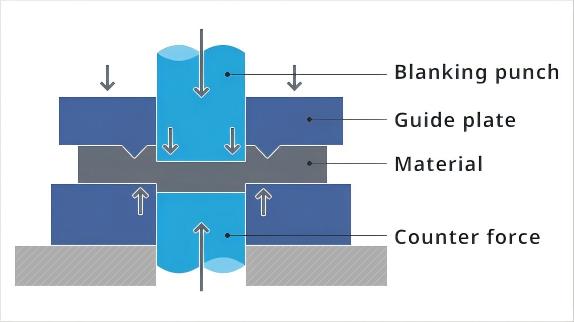
Fine blanking uses main blanking force, V-ring/blank holder force and counter/ejection force together. These pressures must be adjusted as a system, not as isolated numbers.
 Hubei Fine BlankingPrecision Press Systems
Engineering resource
This guide explains fine blanking from a buyer and process-engineering perspective: how the process works, when it reduces secondary machining, what data affects press selection, and how to avoid common quality problems before ordering equipment or tooling.
What is fine blanking?
Fine blanking is different from ordinary punching because the material is held and supported during the cut. A V-ring, blank holder force and counter pressure reduce material movement, helping the part achieve smoother edges, better flatness and more stable dimensional accuracy.
It is most useful when a part would otherwise need stamping plus shaving, drilling, milling, grinding, reaming or heavy deburring. For the right part, one controlled press stroke can reduce handling, shorten lead time and improve repeatability.
Fine blanking uses main blanking force, V-ring/blank holder force and counter/ejection force together. These pressures must be adjusted as a system, not as isolated numbers.
The V-ring restrains material flow before shearing, helping the part stay flat and reducing rollover when the die and press are matched correctly.
Compared with ordinary punching, fine blanking can produce a higher percentage of clean shear surface and reduce shaving, milling or grinding on suitable parts.
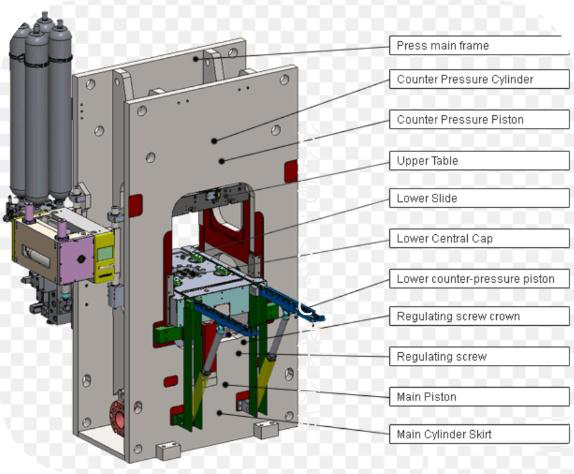
High precision requires a rigid press, accurate guide system, stable hydraulic control and a die designed around the part geometry and material behavior.
Machine selection
Do not select a fine blanking press by tonnage name alone. The projected cutting area, material strength, die size, part ejection, feeding width and finishing requirement all affect the correct machine and auxiliary equipment.
Material and tooling
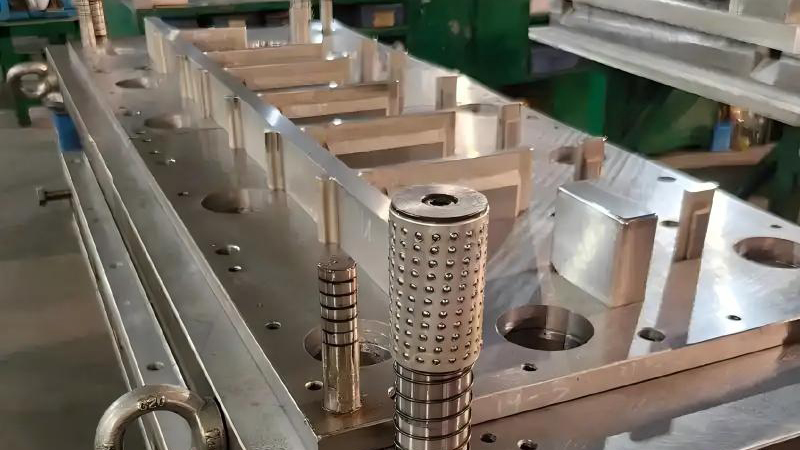
Material behavior affects cutting load, rollover, burr, die wear and flatness. Tooling design must define V-ring geometry, cutting clearance, punch/die material, coating, heat treatment and easy-wear insert strategy according to production volume.
HFB can review part drawings before recommending an HF-series press, Feintool-compatible tooling support, feeding equipment and deburring options.
Troubleshooting guide
| Problem | Likely engineering checks |
|---|---|
| Large burr | Check die clearance, punch wear, material hardness, counter pressure and burr direction requirement. |
| Poor flatness | Review V-ring force, counter pressure, material stress, part geometry and ejection timing. |
| Edge cracking | Confirm material ductility, tensile strength, grain direction, cutting clearance and lubrication. |
| Pitch or hole drift | Inspect servo feeder accuracy, strip guidance, pilot design, die wear and press alignment. |
| Short die life | Review tooling steel, coating, heat treatment, lubrication, material hardness and maintenance cycle. |
When fine blanking pays back
Fine blanking is not the cheapest route for every stamped part. It becomes valuable when clean edges, accurate holes, flatness, forming features or reduced secondary processing improve the whole cost model.
A serious feasibility review compares press investment, tooling cost, material utilization, machining elimination, quality loss, labor, output and long-term die maintenance.
RFQ checklist
HFB support
Hubei Fine Blanking Machinery can support press selection, fine blanking die design, decoiler-straightener-feeder configuration, deburring, refurbishment and process troubleshooting. The practical output is a production route, not just a machine quote.
Send Drawing for Review